Connect Four Two Player: The Ultimate Strategy for Human Opponents
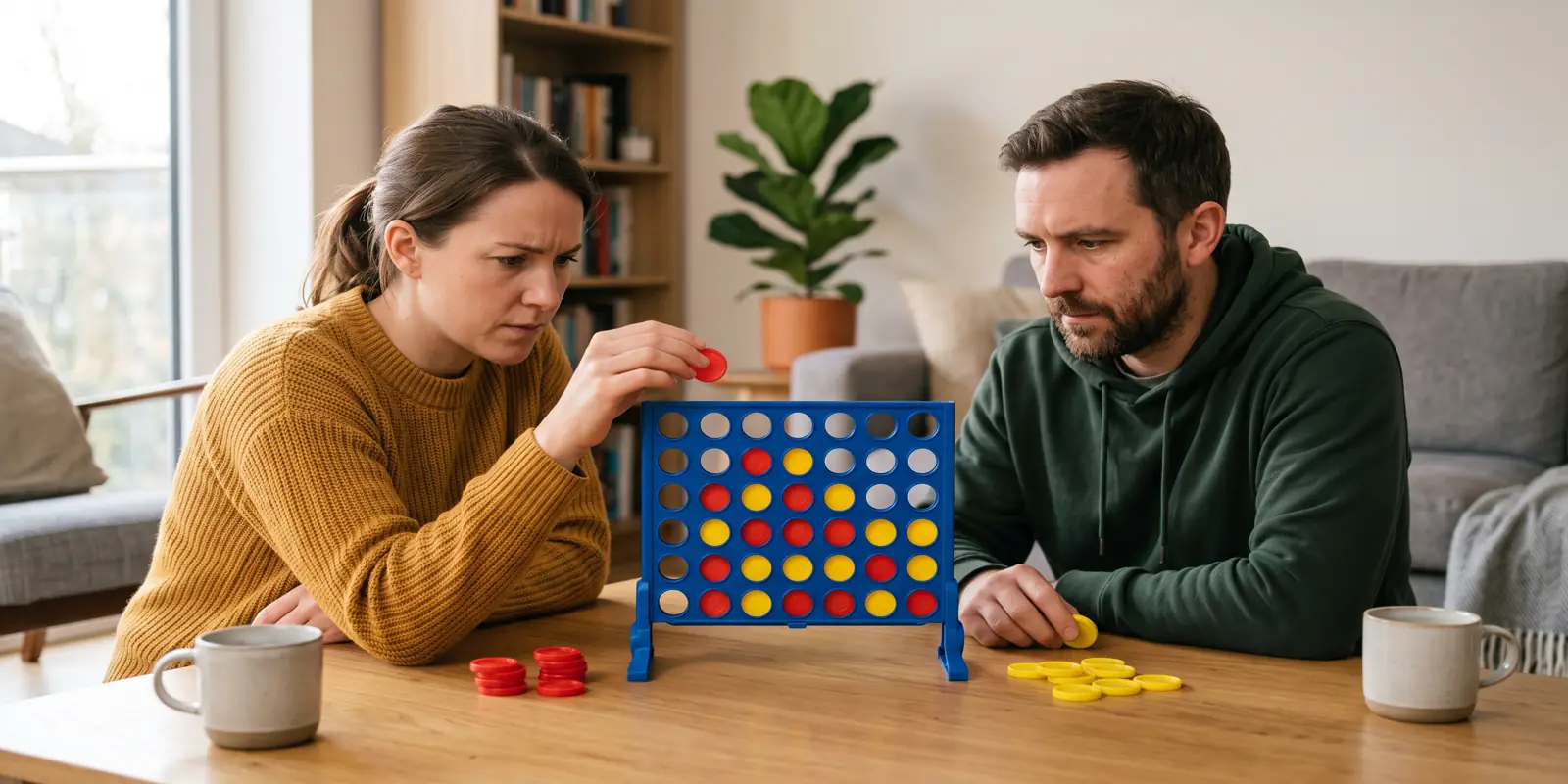
In a Connect Four two player match, the best practical strategy is to control the center, check immediate wins before every move, and build two threats at once. Human opponents also reveal habits: they repeat favorite columns, chase obvious threes, and often miss the square their own disc makes playable. A consistent scan beats guesswork.
This guide gives you a turn-by-turn system for face-to-face or online games against another person. For the complete theory behind center control and threat building, start with our Connect Four Strategy Guide. Then use the focused tactics below to turn that theory into wins against friends.
Table of Contents
- The Connect Four Two Player Move Checklist
- Play Differently When You Go First or Second
- Control the Center Without Becoming Predictable
- Build a Double Threat
- Read a Human Opponent
- Defend Without Giving Away the Next Move
- Connect Four Two Player Online Practice
- Frequently Asked Questions
- Play Connect Four Online
The Connect Four Two Player Move Checklist
Before you drop a disc, scan the board in this order:
- Can I win now? Check every playable square, not only the column you were planning to use.
- Can my opponent win next turn? If yes, block unless you already have an immediate win.
- Does my move make the square above it dangerous? Gravity means every disc becomes support for a future move.
- Can I create two threats? One threat is blockable; two playable threats can end the game.
- Which central move keeps the most plans alive? Prefer flexible moves when no tactic is urgent.
This takes only a few seconds once it becomes a habit. It also prevents the most frustrating loss in two player Connect Four: concentrating on your attack while your opponent has a one-move win elsewhere.
If any part of the win condition or gravity rule is unclear, review how to play Connect Four before adding strategy. Accurate board reading starts with automatic rules knowledge.
Play Differently When You Go First or Second
Your role changes the job.
If You Move First
Open in the center column. The middle participates in more possible horizontal and diagonal lines than an edge, so it gives your first disc more ways to matter later. Our guide to the best opening move in Connect Four explains the geometry in detail.
After the opening, build outward rather than stacking the center automatically. Your advantage is initiative: make threats that force replies and use those replies to improve a second line.
Standard 7×6 Connect Four is a solved first-player win with perfect play, as documented in Victor Allis's Connect Four research. That does not mean a center opening guarantees a casual win. It means the first player has a theoretical route; you still have to find good moves.
If You Move Second
Your first priority is disruption. Contest the central columns and refuse to let the first player build freely on both sides of the middle. Do not mirror every move automatically: a mirror response can look tidy while leaving the opponent in control of the timing.
As the second player, aim to survive the opening with a flexible position. Look for counter-threats that make the first player defend instead of continuing their plan. A useful defensive move blocks something real and adds a red or yellow disc to one of your own future lines.
Control the Center Without Becoming Predictable
Center control is valuable, but “always play column four” is not a strategy. A human opponent will notice repetition and use your stack as support.
Treat columns three, four, and five as a connected central zone. Early discs there can participate in several directions, while an early edge disc has fewer routes. When two moves are equally safe, choose the more central one. When a central move enables an opponent's win above it, choose safety instead.
Ask one extra question after every central move: What can land on top of this disc? Many diagonal losses begin with a move that seemed harmless because the player looked only at the occupied square, not the newly playable one above it.
Build a Double Threat
A double threat gives you two playable winning squares on your next turn. Your opponent can cover only one, so the other remains available. This is the cleanest practical finish against a human opponent.
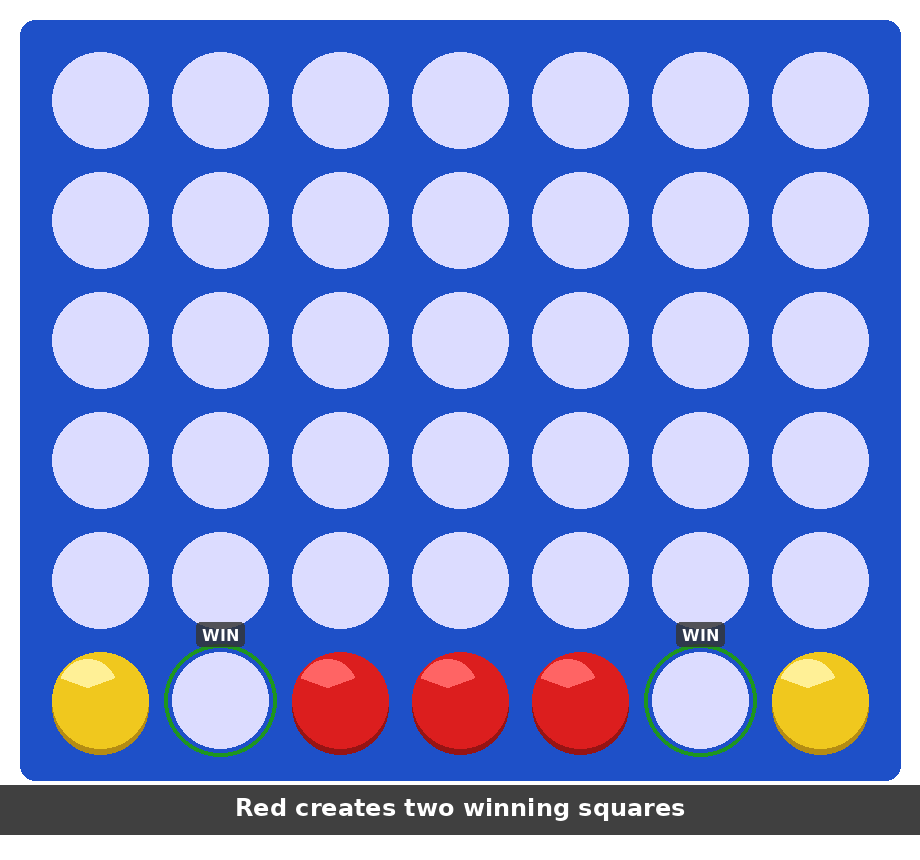
In the diagram, Red's three center discs can be extended at either end. Yellow has one move and cannot occupy both marked squares. The pattern is simple because both winning squares are already supported by the bottom of the board.
Use this example as a thinking model, not a sequence to memorize:
- Keep more than one direction open.
- Make sure the intended winning squares are playable under gravity.
- Create the second threat before revealing the first when possible.
- Break an opponent's fork early; once both wins are live, the defense is usually too late.
For more fork setups and defensive patterns, read How to Win at Connect Four: 7 Strategies That Actually Work.
Read a Human Opponent
Perfect-play theory matters, but real two-player games are decided by repeatable human mistakes. Watch for tendencies during the first few turns:
- The column repeater keeps stacking one lane. Check for the vertical threat, then use the predictable stack as support for a diagonal.
- The automatic blocker answers every visible pair. Offer a harmless threat to pull their disc into a square that helps your real plan.
- The edge builder avoids the center. Occupy central space and build horizontally toward their side.
- The fast mover commits as soon as a move looks good. Complicate the board with intersecting diagonal and horizontal possibilities.
- The mirror player copies your shape. Break symmetry with a forcing move instead of continuing a pattern they can repeat.
Do not rely on bluffs that require an illegal or impossible move. The strongest “psychology” is simply presenting more information than your opponent can scan quickly while your own checklist stays disciplined.
Defend Without Giving Away the Next Move
Blocking is not finished when the immediate threat disappears. Your disc changes the board, so inspect the square above your block and every diagonal through it.
Use this defensive priority:
- Take your own immediate win.
- Block their immediate win.
- Stop a developing double threat.
- Create a counter-threat that forces them to respond.
- Improve center control and future support.
The fourth step is what turns defense into initiative. If you only block, your opponent chooses the questions and you keep supplying answers. A counter-threat makes them spend a move on your plan.
Also distinguish a playable threat from a floating one. Three discs can point toward an empty winning square, but that square is not urgent if empty cells remain below it. Sometimes blocking the floating square's support is stronger than occupying the apparent winning square later.
Connect Four Two Player Online Practice
Short, deliberate practice works better than playing ten rushed games. Use this sequence with a friend:
- Games 1–3: Say the five-step move checklist silently before every turn.
- Games 4–6: Track only the square each move makes playable above it.
- Games 7–9: Try to create one double threat, even if you do not complete it.
- Game 10: Review the first move where the eventual winner gained a forced advantage.
You can run the same drill in Connect Four two player online play or start a game directly on PlayConnectFour.com. Alternate who goes first so both players practice initiative and disruption.
Frequently Asked Questions
What is the best strategy for Connect Four two player games?
Use a fixed move order: win now, block an immediate loss, inspect the square above your move, look for a double threat, then prefer the center. That checklist catches urgent tactics before you commit to a longer plan.
Is Connect Four always won by the first player?
The standard game is a theoretical first-player win under perfect play. Human games are not automatic; either player can win after a mistake. Going second demands more careful disruption and counter-threats.
Should the second player copy the first player's moves?
Not as a default strategy. Mirroring can preserve symmetry for a while, but it leaves the first player choosing the timing. Respond to threats and central control instead of copying mechanically.
How do you beat someone who always blocks?
Build two threats that become playable together, or use a forcing threat to make their blocking disc support your next line. One obvious threat is easy to stop; intersecting plans are harder to defend.
Can two people play Connect Four online?
Yes. Two players can play on the same device or use an online multiplayer game. For the simplest start, open PlayConnectFour.com and invite a friend.
Play Connect Four Online
The fastest way to improve against human opponents is to practice the checklist until it becomes automatic. Review the board, make one purposeful move, and check what your disc unlocks above it.
Play Connect Four Online with a friend now. Then read our Strategy Guide for deeper opening, mid-game, and defensive ideas.