Best Opening Move in Connect Four: What the Math Says

The best opening move in Connect Four is the center column. On a standard 7-column board, that means column 4 if you count from the left, or column 3 if your app uses zero-based numbering. The math is unusually clear here: standard Connect Four has been solved, and perfect first-player play starts in the middle column.
That does not mean one center chip wins the game by itself. It means the center gives you the most flexible first position: more horizontal possibilities, more diagonal possibilities, and better control over the columns your opponent wants later. If you want the full strategic foundation, keep our Connect Four strategy guide open next to this opening-focused guide.
Table of Contents
- The Direct Answer: Play the Center First
- Why the Center Is the Best Opening Move in Connect Four
- What Perfect Play Actually Proves
- If You Move Second, Contest the Center
- The First Three Moves: A Human-Friendly Plan
- Opening Moves to Avoid
- How to Practice Connect Four Opening Moves
- FAQ: Best Opening Move Connect Four
- Practice the Opening
The Direct Answer: Play the Center First
If you are first to move, drop your first chip into the center column.
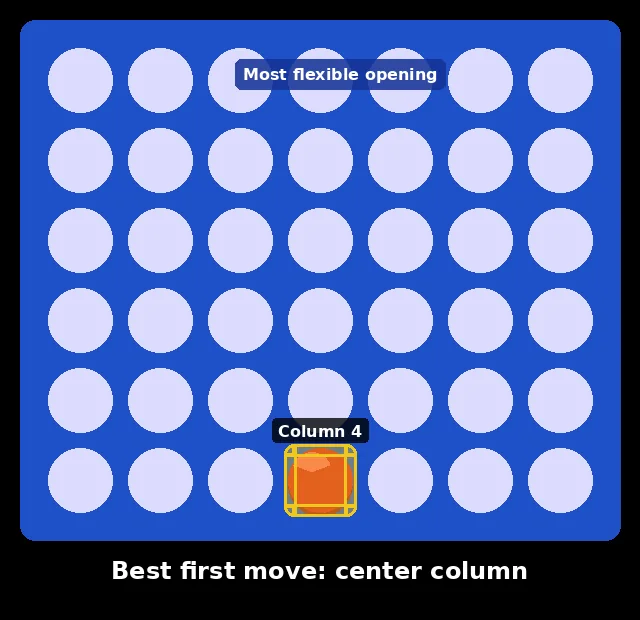
This opening is strongest because a center chip participates in more possible four-in-a-row lines than an edge chip. From the middle, you can build left, right, upward, and diagonally in both directions. From the edge, half of those routes disappear.
For practical play, remember this simple rule:
- First move: play center.
- If center is unavailable later, prefer the adjacent columns.
- Avoid drifting to the edges unless you are blocking a real threat or finishing a plan.
That one habit will make your openings sturdier immediately. It also connects directly to the patterns in How to Win at Connect Four, where center control becomes forks, forced blocks, and diagonal setups.
Why the Center Is the Best Opening Move in Connect Four
Connect Four is geometry with gravity. The board has seven columns, so the fourth column sits at the middle of every horizontal row. A chip there can become part of many different four-chip lines:
- Horizontal lines that extend both left and right.
- Vertical stacks in the most valuable column.
- Rising diagonals toward either side.
- Falling diagonals toward either side.
An edge-column chip can still win, but it has fewer partners. It can only extend inward for horizontal lines, and its diagonal options are limited by the side of the board. That lower flexibility matters from move one because every later move builds on the shape of your opening.
The center is also hard for your opponent to ignore. If they let you keep stacking and branching from the middle, your future threats multiply. If they spend early moves contesting it, they are reacting to you instead of building a clean attack of their own.
What Perfect Play Actually Proves
The strongest evidence for the center opening comes from solved-game analysis. The standard 7-column by 6-row version of Connect Four is a solved game: with perfect play, the first player can force a win by starting in the middle column. The game was solved independently by James Dow Allen and Victor Allis in 1988, a result summarized in the Connect Four mathematical solution overview and in the Connect 4 Solver project.
John Tromp's Connect Four research pages also document the solved-game history and the scale of the search problem. The useful takeaway for human players is not "memorize the full solution." The useful takeaway is this:
The opening column changes the value of the whole game.
Perfect play says the center opening gives the first player a forced-win path. Openings next to the center are much safer than edges, but they do not give the same winning proof. Outer-column openings are the easiest way to hand your opponent the better game.
If You Move Second, Contest the Center
If your opponent opens in the center, do not answer on the far edge. Play one of the adjacent columns instead: column 3 or column 5 in human counting.
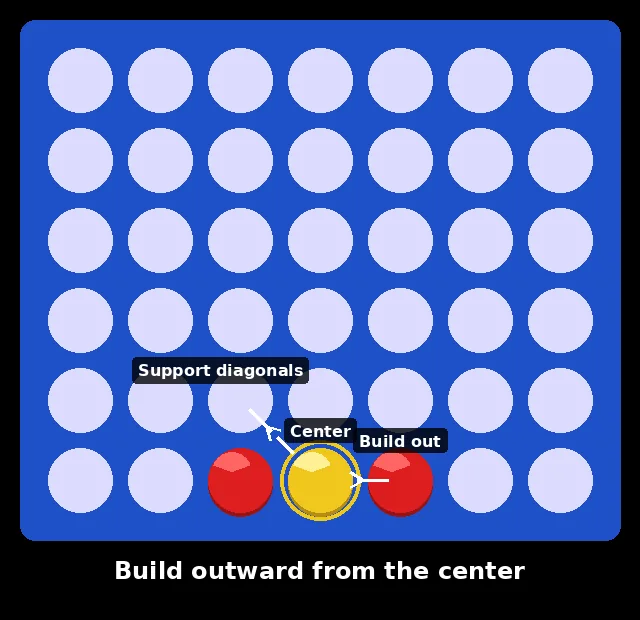
The goal is not to "take back" the center in one move. You cannot remove their chip. Your goal is to limit how freely they build around it. Adjacent-column responses keep you close enough to block horizontal growth, support your own diagonals, and avoid giving the first player a huge central space advantage.
If your opponent opens away from the center, take the center yourself. You are not guaranteed to win, but you have claimed the most flexible square while they used their first move on a weaker column.
The First Three Moves: A Human-Friendly Plan
You do not need to memorize a computer opening book to play better openings. Use this plan for your first few moves:
Move 1: Claim or Contest the Center
If you move first, play center. If you move second and the center is open, take it. If the center is already occupied, play adjacent.
Move 2: Build Outward, Not Sideways to the Edge
After your first central chip, look for a move in a neighboring column that supports future diagonals. A strong second move often looks quiet because it does not threaten an immediate win. That is fine. Openings are about flexibility, not flash.
Move 3: Check Their Immediate Threat Before Expanding
Before you place your third chip, scan for your opponent's playable threats. If they can win next move, block. If not, keep building from the middle. This is where the ideas from Connect Four game theory become practical: every chip creates support for the square above it, so your opening should avoid giving your opponent an easy diagonal platform.
Opening Moves to Avoid
Some opening moves are not automatically losing in casual play, but they make the game harder than it needs to be.
Avoid the Far Edge First
The far-left and far-right columns give you the fewest winning routes. They also make it harder to fight for the center later. If your opponent knows what they are doing, an edge opening gives them a comfortable start.
Avoid Stacking One Column Too Early
Two or three chips in the same column can become a vertical threat, but early vertical stacks are easy to see and block. Worse, they may give your opponent useful landing squares beside or above your stack.
Avoid Blocking Harmless Shapes
Not every two-in-a-row is a real threat. In the opening, beginners often waste central moves blocking patterns that cannot win yet. Ask whether the winning square is playable. If it is floating above empty space, you probably have time to build your own position.
Avoid Copying Without Thinking
Mirroring your opponent feels safe, but it rarely creates initiative. Use symmetry only when it helps you contest the center or block a concrete threat. Otherwise, make moves that improve your future threats.
How to Practice Connect Four Opening Moves
The best way to learn openings is to isolate them. Do not play ten random games and hope the idea sticks. Practice with a narrow goal.
Try this routine:
- Play five games where your only opening rule is "center first, adjacent second."
- Play five games where you pause after move three and count possible diagonals.
- Play five games where you deliberately avoid the edge columns unless blocking.
- Review each loss and identify whether the mistake came from the opening, the first missed threat, or a later tactical error.
For broader practice, use the older Mastering Connect Four tips and strategies guide as a checklist after your opening feels automatic.
FAQ: Best Opening Move Connect Four
What is the best opening move in Connect Four?
The best opening move in Connect Four is the center column. On the standard 7-column board, that is column 4 when counting from the left.
Why is the center column best?
The center column touches more potential winning lines than the edges. It supports horizontal, vertical, and diagonal plans while keeping your future moves flexible.
Can the first player always win with the center opening?
With perfect play, yes: the solved standard game is a first-player win when the first move is in the middle column. In human games, the center does not guarantee a win by itself because mistakes still decide most games.
What should I play if my opponent starts in the center?
Play an adjacent column. That contests the central area, supports your own diagonals, and avoids giving the first player too much room.
Is an edge opening always bad?
It is usually weaker, especially for beginners. Edge openings have fewer winning lines and make it harder to control the board's most important columns.
Practice the Opening
The opening is not the whole game, but it sets the shape of everything that follows. Start in the center, build outward, avoid early edge moves, and check whether each chip creates useful support or gives your opponent a gift.
Ready to test it? Play Connect Four online and practice the center opening for a few games. Then read our full Connect Four Strategy Guide and the tactical How to Win at Connect Four guide to turn a strong opening into more finished wins.