How to Win at Connect Four: 7 Strategies That Actually Work

If you want to know how to win at Connect Four, the short answer is this: control the center, build threats before your opponent does, and force positions where they cannot block everything. Connect Four is not won by dropping random chips and hoping for a mistake. It is won by shaping the board so your opponent's “safe” move still helps your next attack.
This guide gives you seven strategies that actually work in real games. If you're brand new, start with our complete guide on how to play Connect Four. If you already know the rules and want the deeper theory behind these ideas, keep our Connect Four strategy guide open too.
Table of Contents
- How to Win at Connect Four: The Core Idea
- 1. Control the Center Column
- 2. Think in Threats, Not Single Moves
- 3. Build From the Bottom Up
- 4. Create Two-Way Threats
- 5. Watch Diagonals Before They Look Dangerous
- 6. Block Immediate Wins First
- 7. Count the Endgame Before the Board Fills
- Common Mistakes That Cost Games
- FAQ: How to Win at Connect Four
- Practice the Strategies
How to Win at Connect Four: The Core Idea
The key to winning Connect Four is not memorizing one magic move. The standard 7×6 game has been mathematically solved — James Dow Allen and Victor Allis independently showed in 1988 that the first player can force a win with perfect play, especially by opening in the center. You can read more about that in the Connect Four overview on Wikipedia and the Connect 4 Solver project.
But in normal human games, nobody plays perfectly. That is good news. You do not need a computer-perfect solution to win more often. You need a repeatable decision system:
For head-to-head games with friends, our Connect Four two player strategy guide turns that system into role-specific first-player, second-player, and opponent-reading tactics.
- Take the most valuable spaces first.
- Create threats your opponent must answer.
- Prefer moves that create more than one future win.
- Block immediate losses before chasing your own plan.
- Keep track of which player will be forced to play critical columns late.
Those five rules are the backbone of every strategy below.
1. Control the Center Column
The fastest way to improve is to value the center column more than the edges. On a standard Connect Four board, center chips participate in more possible four-in-a-row lines than edge chips. A disc in the middle can support horizontal, vertical, and diagonal wins in both directions. A disc on the far left or far right has fewer paths.
That does not mean you should blindly play the center every turn. It means that when two moves look equally good, the more central move is usually stronger.
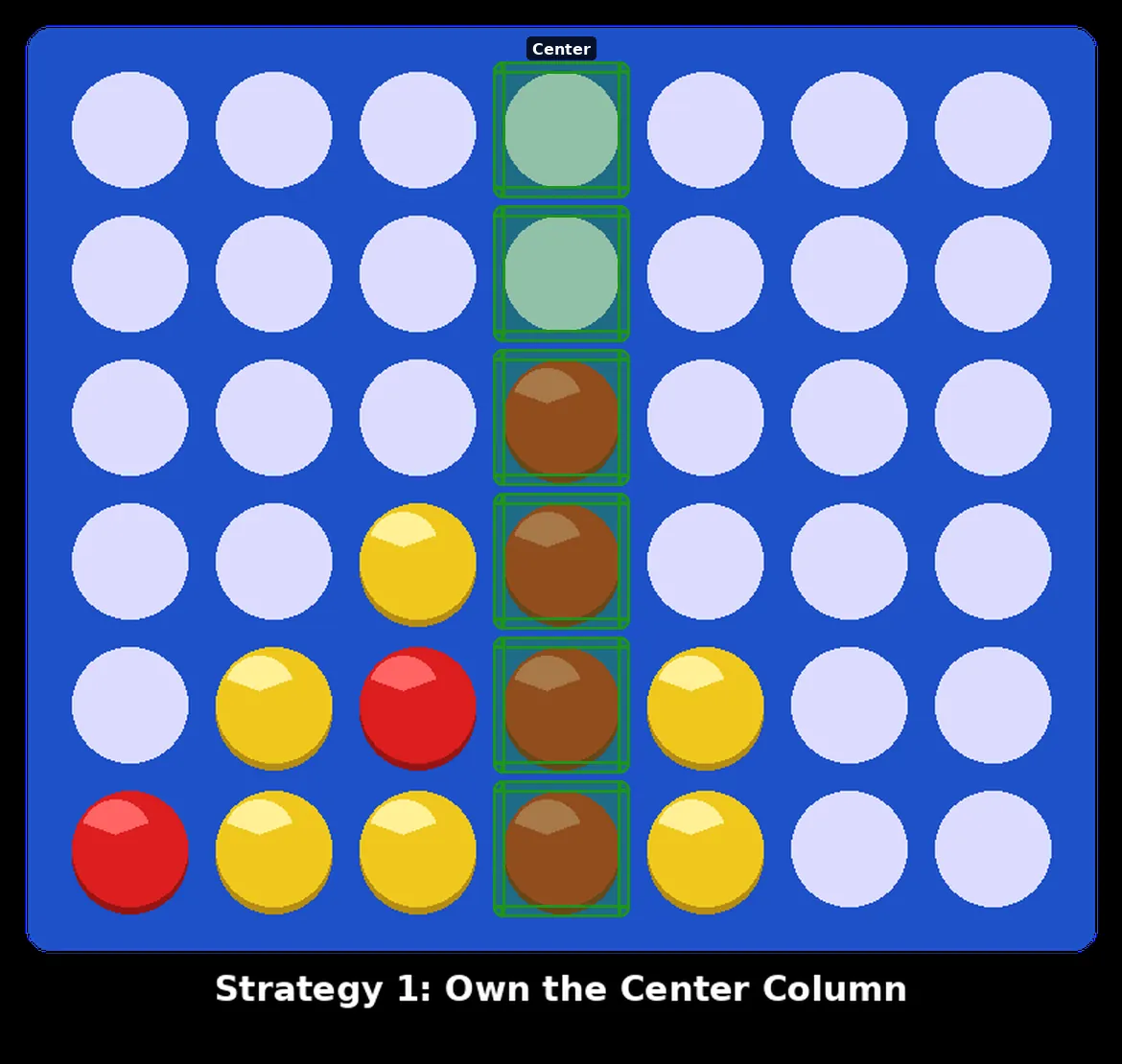
Use center control like this:
- Open in the center if you move first. Column 4 in human counting, or column 3 in zero-indexed board notation, is the strongest starting point.
- Contest the center if you move second. If your opponent starts center, play adjacent rather than drifting to the edge.
- Build outward from center. A central base lets you create horizontal and diagonal threats later.
- Avoid early edge stacks. Edge columns can still win, but they are less flexible.
If you only remember one beginner strategy, remember this one: center chips give you more futures.
2. Think in Threats, Not Single Moves
Beginners look for three-in-a-row. Stronger players look for threats.
A threat is an empty space where a player can win on a future move. The important part is not just the three chips you already have; it is whether the winning square is actually playable. Because Connect Four uses gravity, an empty square floating above empty spaces cannot be played yet. You must build the support below it first.
For example, a diagonal pattern may look scary, but if the winning square is two rows above the current stack, it is not an immediate threat. A horizontal three on the bottom row, however, is urgent because the fourth spot can be played right away.
When evaluating a move, ask:
- What winning square does this create?
- Is that square playable now, or does it need support?
- If my opponent blocks it, what second threat do I get?
- Am I accidentally giving my opponent support for their own diagonal?
This threat-based thinking is the difference between “I hope this works” and “I know what my opponent must do next.”
3. Build From the Bottom Up
Every advanced Connect Four pattern starts with boring-looking foundation moves. The board is vertical, so future wins depend on what has already been stacked underneath them. If you want a diagonal win on row 3, somebody has to fill the lower rows first.
That is why early random moves are so costly. A careless disc can become a stepping stone for your opponent's diagonal later. Before dropping a chip, look one or two rows above it and ask, “Who benefits from the square I am supporting?”
A good foundation move usually does at least one of these things:
- Adds to center control.
- Supports a future diagonal for you.
- Blocks support for your opponent's diagonal.
- Keeps multiple columns playable instead of locking you into one plan.
A bad foundation move does the opposite: it gives your opponent the exact platform they need to complete a diagonal or fork.
If you're unsure, pause and inspect the diagonal lines that pass through your move. Most surprise losses happen because a player blocks the obvious horizontal threat while quietly building the opponent's diagonal landing pad.
4. Create Two-Way Threats
The best way to win at Connect Four is to create a position where you threaten two different wins at once. Your opponent gets only one move per turn, so if both winning squares are playable, they can block one and lose to the other.
This is often called a fork or double threat. It is the reason strong players do not chase the first available three-in-a-row. They build positions where a single move creates two threats.
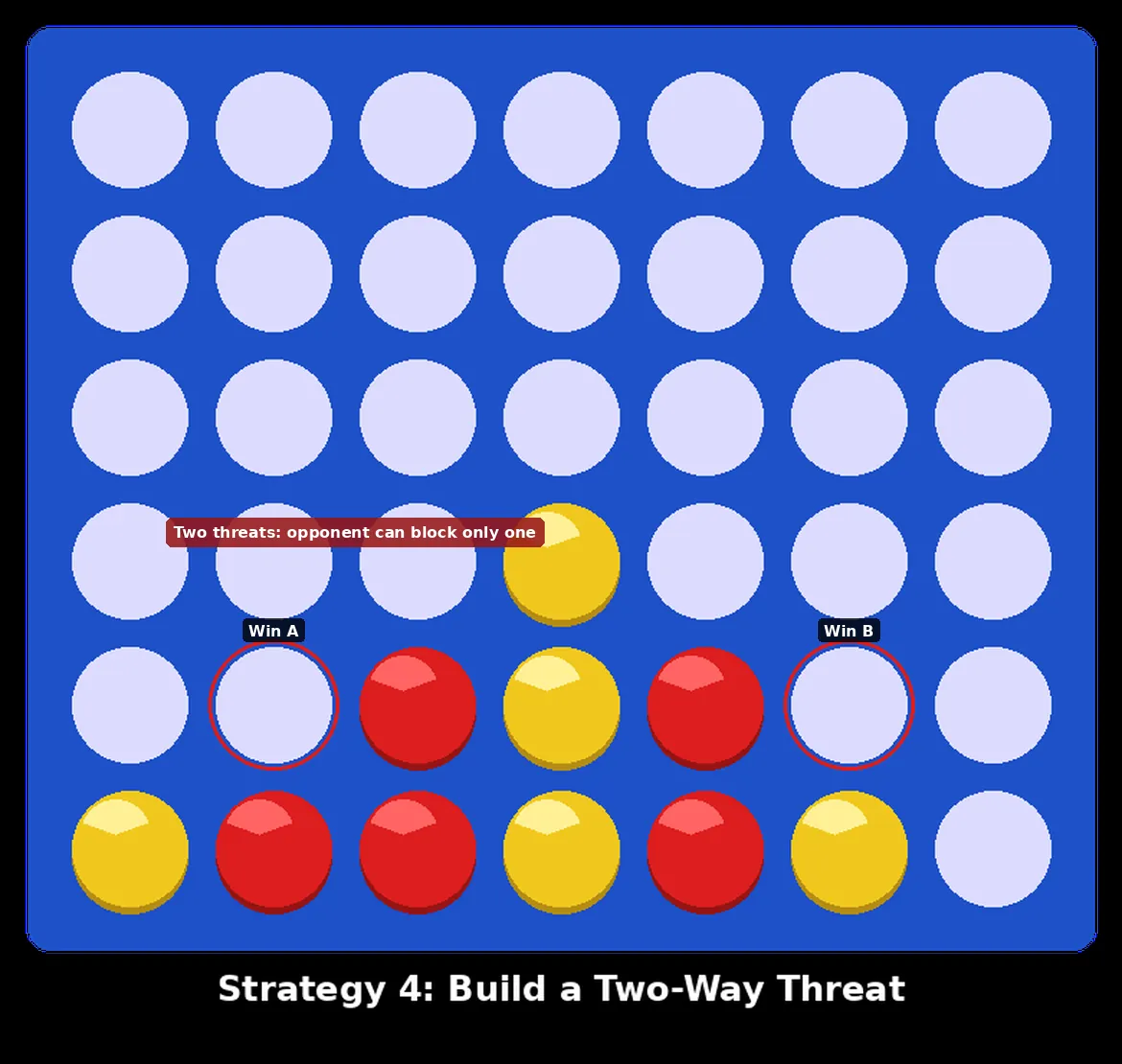
To create two-way threats:
- Build connected chips in the center lanes.
- Keep at least two possible winning directions alive.
- Avoid spending your attack on a threat that is easy to block.
- Wait until both winning squares are playable before forcing the issue.
A simple example is a horizontal line that can be completed on either end. Another is a position where one move creates both a diagonal threat and a horizontal threat, like the Figure 7 Trap below.
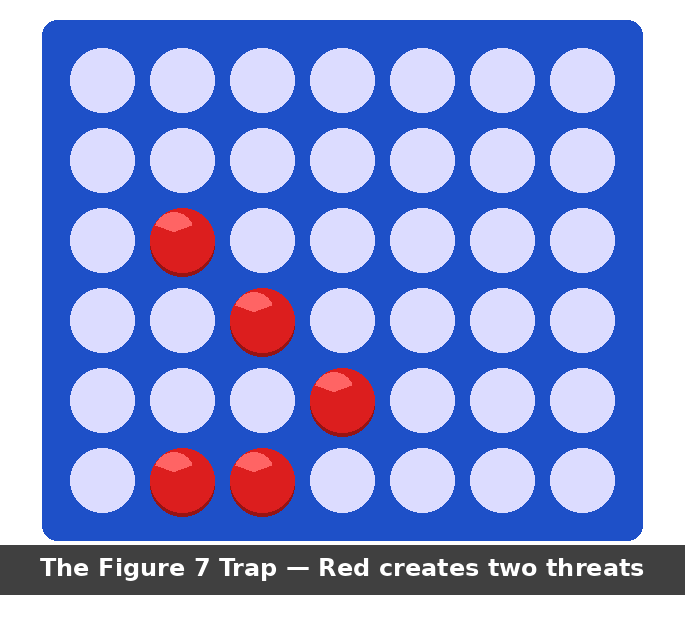
When you see your opponent building one of these, do not wait until the final move. Break the shape early.
5. Watch Diagonals Before They Look Dangerous
Horizontal and vertical threats are easy to see. Diagonals are where casual players get ambushed.
A diagonal win needs support on every lower square, which makes it look harmless until the last moment. But once the support exists, the winning move can appear instantly. This is why your defensive scan should always include diagonals, even when your opponent has only two chips lined up.
Use this quick scan after every opponent move:
- Did their move create or support a rising diagonal?
- Did it fill a square under a future diagonal win?
- Are they building from the center toward an edge?
- Do they have two diagonal paths crossing the same area?
Diagonal awareness also helps your offense. If your opponent focuses only on blocking horizontal lines, you can quietly prepare a diagonal that becomes unblockable later.
For a deeper breakdown of opening and mid-game patterns, read the broader Connect Four strategy guide. This post is the practical checklist; the pillar guide explains why the patterns work.
6. Block Immediate Wins First
This sounds obvious, but it is the most common way people lose: they see an exciting attack for themselves and miss the opponent's immediate win.
Before every move, run this three-second checklist:
- Can my opponent win on their next move?
- If yes, can I block that square?
- If I cannot block it, do I have my own immediate win?
- If neither player has an immediate win, what move creates the strongest future threat?
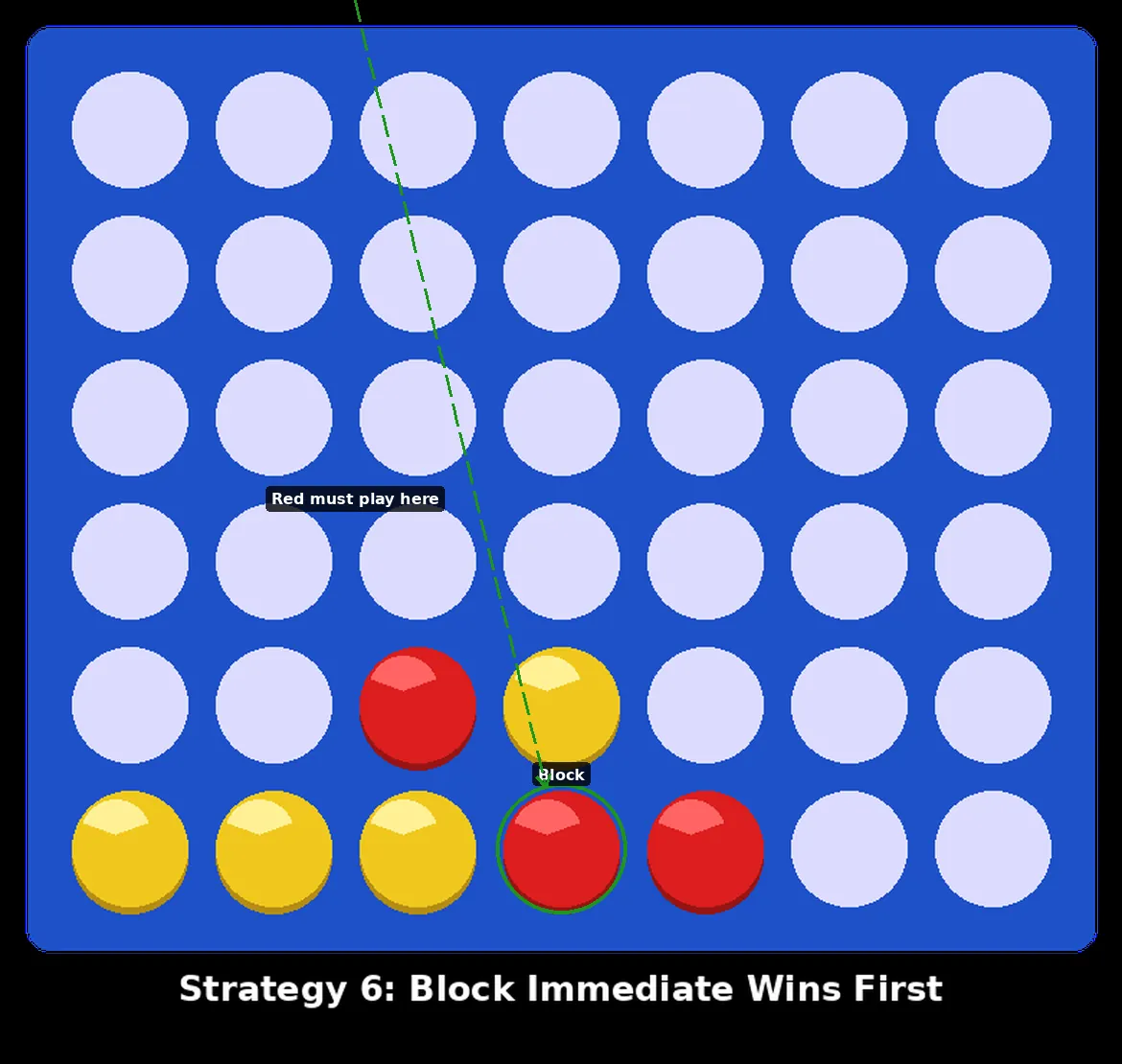
The only time you ignore an opponent's immediate threat is when you can win immediately yourself. Otherwise, block first. A brilliant two-move plan does not matter if the game ends before your next turn.
Also watch for traps where blocking one threat gives support to another. If your opponent has arranged a vertical threat above a horizontal landing square, the obvious block may be exactly what they wanted. This is why you should scan the whole board, not just the row where the threat appears.
7. Count the Endgame Before the Board Fills
Late-game Connect Four becomes a counting game. When many columns are nearly full, players can be forced to drop into dangerous spaces. Sometimes the winning move is not available now, but it will become unavoidable because the turn order forces your opponent into a column.
This is where “odd and even threats” matter. In simple terms, some winning squares are favorable because of who will be forced to play that height first. You do not need to calculate the entire solved game tree, but you should notice when a column is becoming a trap.
In the endgame:
- Count how many empty spaces remain in critical columns.
- Avoid playing under an opponent's winning square unless you must.
- Preserve safe columns for yourself.
- Force your opponent to spend moves in columns that do not improve their threats.
- Prefer moves that leave them with only bad choices.
If a column contains a dangerous square, do not treat it as “empty space.” Treat it as a timer. Every chip dropped there brings the game closer to that threat becoming playable.
Common Mistakes That Cost Games
Even good players lose when they slip into these habits.
Playing the Edge Too Early
Edge columns look safe, but they create fewer winning lines. If your opening moves live on the edges while your opponent owns the center, you will spend the game reacting.
Blocking Every Tiny Threat
Not every two-in-a-row matters. If you block harmless shapes while your opponent builds central control, you are trading your moves for their plan. Block real threats, especially playable winning squares.
Creating Support for the Opponent
Before you drop a chip, check the square above it. If that square completes your opponent's diagonal, your “defensive” move may be a gift.
Forgetting the Rules Under Pressure
If you are still shaky on win conditions, draws, or how gravity affects legal moves, review how to play Connect Four first. Strategy gets much easier when the rules are automatic.
Not Practicing Against Real Opponents
Reading strategy helps, but pattern recognition comes from games. After studying this guide, play Connect Four online and deliberately practice one idea at a time: center control for five games, diagonal scanning for five games, two-way threats for five games.
FAQ: How to Win at Connect Four
What is the best first move in Connect Four?
The best first move is the center column. On the standard 7-column board, the center gives the most possible winning lines and is part of the known perfect-play first-player win.
Can you win Connect Four every time?
With perfect play, the first player has a forced win in standard Connect Four. In normal human games, you cannot guarantee a win every time, but you can win much more often by controlling the center, building forks, and blocking immediate threats.
Should I always block my opponent?
Block immediate wins every time unless you have your own immediate winning move. For smaller threats, compare the danger against your own attacking chances. Strong players do not block everything; they block what matters.
What is the strongest Connect Four strategy for beginners?
Start with three habits: open near the center, check whether your opponent can win next move, and look for two-way threats. Those habits alone will beat many casual players.
Are diagonals more important than horizontal wins?
Not more important, but easier to miss. Horizontal wins are visible, so both players usually notice them. Diagonals often develop quietly because they need support from lower rows.
Practice the Strategies
The fastest way to learn how to win at Connect Four is to practice with intention. Do not try to master every pattern at once. Pick one strategy from this guide, play several games focusing only on that skill, then add the next.
Here is a simple practice plan:
- Games 1–3: Open center and build outward.
- Games 4–6: Pause before every move and scan for immediate wins.
- Games 7–10: Try to create one two-way threat per game.
- After that: Review losses and identify whether you missed a diagonal, gave support, or ignored a forced block.
Ready to test it? Play Connect Four online now and practice these patterns against a real opponent. Then read our full Connect Four Strategy Guide to go deeper into opening theory, mid-game tactics, and advanced defensive play.