Connect Four Game Theory: Why Every Move Counts

Connect Four game theory sounds academic, but the useful idea is simple: every move changes the future moves available to both players. A chip is not just a chip. It can create a threat, block a threat, support a diagonal, fill a safe square, or force your opponent into a bad column later.
That is why strong players do not only ask, "Can I connect four right now?" They ask, "What will this move make possible two turns from now?" If you already know the basics, this guide will show you the theory behind the tactics in our Connect Four strategy guide and the practical patterns in How to Win at Connect Four.
Table of Contents
- What Connect Four Game Theory Means
- Why Connect Four Is a Perfect Information Game
- The Solved Game: What Perfect Play Tells Us
- Center Control Is a Game Theory Shortcut
- Playable Threats Matter More Than Pretty Patterns
- Forced Moves: The Core of Connect Four Game Theory
- Odd and Even Threats in the Endgame
- How to Use Game Theory Without Becoming a Computer
- FAQ: Connect Four Game Theory
- Practice the Theory
What Connect Four Game Theory Means
Game theory studies decisions where your best choice depends on someone else's choices. Connect Four is a clean example because both players want opposite outcomes, both players see the full board, and every legal move is visible.
In plain English, Connect Four game theory asks:
- Which moves improve my future winning chances?
- Which moves reduce my opponent's future winning chances?
- Which threats are real because the winning square is playable?
- Which columns will become dangerous later because of turn order?
- Can I make a move my opponent must answer?
This is different from memorizing tricks. A trick works only when the opponent misses it. Game theory helps you understand why the trick works, when it fails, and what to do when the board looks unfamiliar.
If you are still learning legal moves, start with how to play Connect Four. The theory makes much more sense once gravity, win conditions, and draws feel automatic.
Why Connect Four Is a Perfect Information Game
Connect Four is a perfect information game. Nothing is hidden. There are no cards in hand, secret roles, dice rolls, or random events after the game starts. Both players can see the same board and the same legal columns.
That makes the game feel fair, but it also makes mistakes expensive. If your opponent can see every threat you create, then a one-move threat is easy to block. Your real goal is to create positions where every response is bad.
Connect Four is also a zero-sum game. A move that helps you usually hurts your opponent, and a move that gives your opponent a new winning square usually costs you. That is why neutral-looking moves matter. Filling a square in the center may not threaten a win immediately, but it can remove your opponent's best landing spot and open two future diagonals for you.
The Solved Game: What Perfect Play Tells Us
The standard 7-column by 6-row version of Connect Four has been solved. The short version: with perfect play, the first player can force a win by starting in the center column. The game was solved independently by James Dow Allen and Victor Allis in 1988, and the broader mathematical history is summarized in the Connect Four article on Wikipedia and Victor Allis's thesis, A Knowledge-based Approach of Connect-Four.
That does not mean humans can casually memorize the full solution. The classic board has trillions of possible legal positions, and even excellent players cannot calculate every branch during a quick game. What the solved result gives you is a set of practical lessons:
- The center column is powerful enough to define perfect-play openings.
- The first player has initiative when they use that center advantage correctly.
- Some moves lose not because they fail immediately, but because they allow a forced sequence later.
- Good play is about controlling future options, not just making visible rows of three.
You can explore computer evaluation yourself with the Connect 4 Solver, which shows how dramatically a single column choice can change a position's value.
Center Control Is a Game Theory Shortcut
The center is not magic. It is valuable because it participates in more possible four-in-a-row lines than the edges. A center chip can support horizontal wins, vertical stacks, and diagonals in both directions. An edge chip has fewer connections.
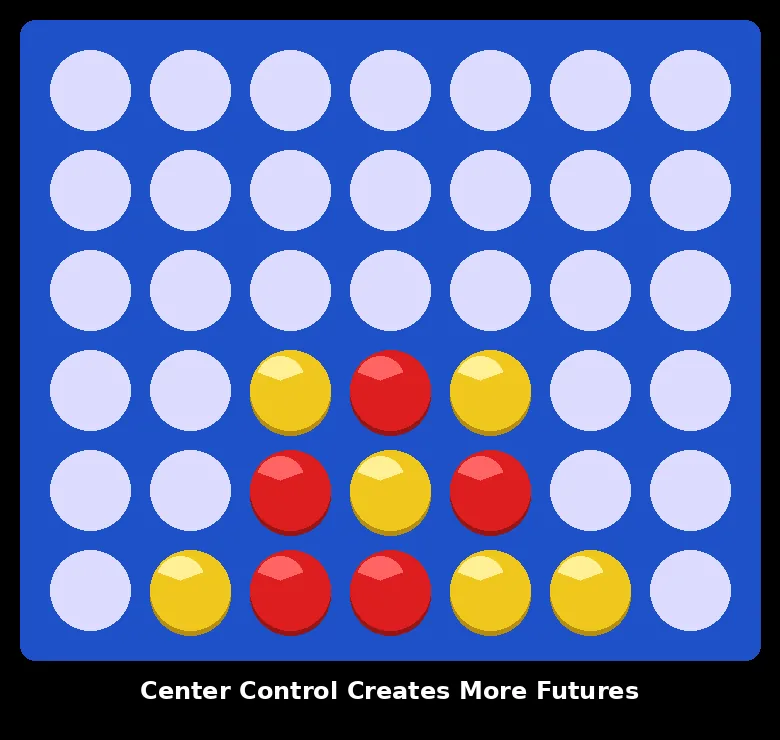
In game theory terms, the center gives you more futures. When you control central squares, you usually have more ways to create a threat on your next move. Your opponent has to watch more directions at once, which makes defensive play harder.
This is why "play the center" is good beginner advice, but the deeper rule is better:
Prefer moves that preserve the most useful future threats.
Sometimes that move is the center. Sometimes it is a neighboring column that supports a diagonal. Sometimes it is a defensive block that also keeps your central structure alive. The best move is the one that leaves you with more strong continuations than your opponent.
Playable Threats Matter More Than Pretty Patterns
Beginners often see three chips in a diagonal and panic. Stronger players ask a sharper question: is the winning square playable?
Because chips fall to the lowest empty space, a threat only matters immediately when the empty winning square has support underneath it. A diagonal gap floating above empty cells is a future idea, not a current win.
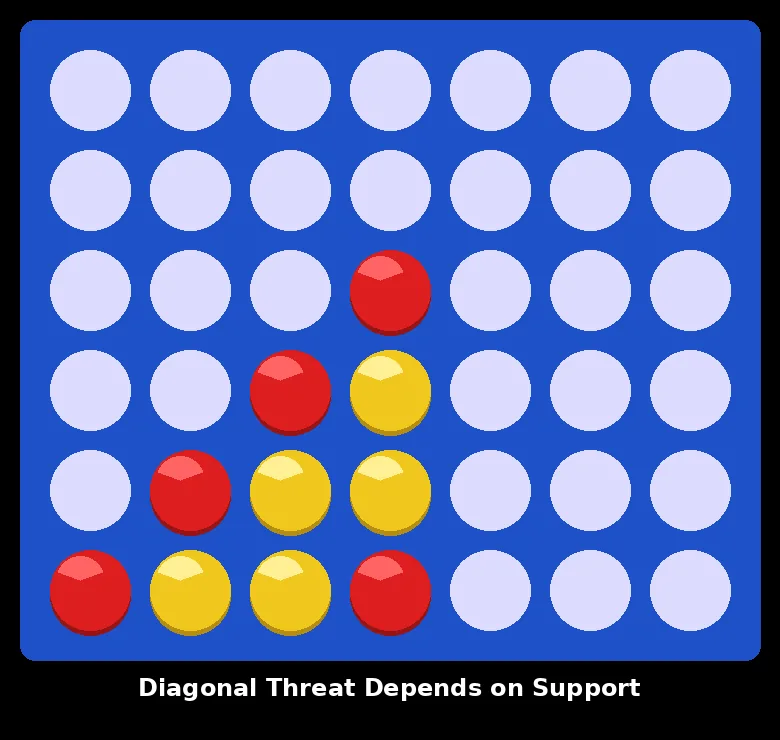
In the diagram, the diagonal is dangerous because the future winning square is supported by the stack below it. Without that support, the same visual pattern would be harmless for now.
This is one of the biggest game theory lessons in Connect Four: the value of a square depends on what sits below it. When you drop a chip, you are not only occupying your square. You are also creating the floor for the square above it. That floor might help you, or it might become the exact platform your opponent needed.
Before every move, ask:
- What square am I giving support to?
- Who benefits from the square above my chip?
- Does this move create a playable threat or only a future possibility?
- Am I blocking a real threat or wasting a move on a shape that cannot win yet?
Forced Moves: The Core of Connect Four Game Theory
A forced move is a move your opponent must answer. If they ignore it, they lose immediately. Forced moves matter because they let you control the tempo of the game.
The simplest forced move is an immediate three-in-a-row with one playable winning square. Your opponent must block it. But the strongest forced moves do more than threaten one win. They make your opponent block in a column that helps your next plan.
For example:
- You create a horizontal threat.
- Your opponent blocks it because they must.
- Their block adds support under a diagonal square.
- You use that newly supported square to create a second threat.
That sequence is why every move counts. Your opponent may think they are defending, but if your threat was chosen well, their defense becomes part of your attack.
This is also the logic behind forks and two-way threats. If one move creates two playable winning squares, the opponent can block only one. The game is decided before the final chip drops, because the losing player has run out of legal answers.
Odd and Even Threats in the Endgame
Late-game Connect Four often becomes a counting problem. A column may contain a dangerous winning square, but nobody can play it yet. The key question becomes: who will be forced to play the lower squares first?
Players often describe this as odd and even threats. You do not need formal notation to use the idea. Just count the empty spaces in a critical column and notice whose turn will land on the dangerous square if both players keep filling it.
Here is the practical version:
- If a column contains your future winning square, avoid filling it too early unless the timing works for you.
- If a column contains your opponent's future winning square, do not give them the exact support they need.
- When the board gets crowded, preserve safe columns so you are not forced into a losing move.
- Watch for columns where every legal move helps the other player.
Many casual games are lost because one player treats the endgame like cleanup. It is not cleanup. It is the moment when earlier supports, threats, and forced moves finally cash out.
How to Use Game Theory Without Becoming a Computer
You do not need to calculate trillions of positions to benefit from Connect Four game theory. You only need a better move checklist.
Use this before every turn:
- Check immediate wins. If you can win now, win.
- Check immediate losses. If your opponent can win next, block unless you already have a win.
- Check playable threats. Ignore pretty patterns that cannot be played yet.
- Check support. Look at the square above your move before you drop the chip.
- Check center value. Prefer central moves when the tactical danger is equal.
- Check forced replies. Ask whether your move makes your opponent respond.
- Check the endgame clock. Count critical columns as they fill.
That is the human version of game theory: reduce the board to choices that matter. You are not trying to solve the whole game. You are trying to avoid moves that hand your opponent the future.
FAQ: Connect Four Game Theory
Is Connect Four solved by game theory?
Yes. Standard Connect Four is solved: with perfect play, the first player can force a win by opening in the center column. For humans, the important lesson is not memorizing the whole solution; it is understanding why center control, forced moves, and playable threats are so strong.
Does the first player always win Connect Four?
Only with perfect play. In casual games, the first player can lose quickly by ignoring threats, playing edges too early, or giving the opponent diagonal support. The solved result tells us what is possible with perfect decisions, not what happens automatically.
What is the most important game theory idea for beginners?
Playable threats. A line is only urgent if the winning square can actually be played. Once you learn to separate real threats from harmless patterns, your defense improves immediately.
Is Connect Four mostly math or strategy?
It is both. The game has a mathematical solution, but human players win through practical strategy: center control, pattern recognition, forks, blocking, and endgame timing.
Practice the Theory
The best way to learn Connect Four game theory is to apply one idea at a time. Play five games where you focus only on playable threats. Then five games where you focus on support squares. Then five games where you try to create forced replies instead of chasing obvious rows of three.
Ready to test it? Play Connect Four online and watch how each chip changes the future board. After that, read our full Connect Four Strategy Guide and the practical How to Win at Connect Four checklist to turn the theory into repeatable wins.