Who Invented Connect Four? The Surprising History Behind the Classic Game

Who invented Connect Four? American toy inventor Howard Wexler developed the familiar vertical game in 1973. His business partner, Ned Strongin, is also widely credited as a designer or co-inventor. Their company licensed the game to Milton Bradley, which introduced Connect Four to the public in February 1974.
That short answer hides a clever design story: painted ping-pong balls, taped plastic tubes, repeated solo tests, and one insight that turned flat tic-tac-toe into a gravity-driven strategy game. If the rules are new to you, read our complete guide to how to play Connect Four before exploring its origin.
Table of Contents
- Who Invented Connect Four?
- How the Man Who Invented Connect Four Built It
- From Prototype to Milton Bradley
- What Was Ned Strongin's Role?
- Why the Design Endured
- Frequently Asked Questions
- Play Connect Four Online
Who Invented Connect Four? The Direct Answer
Howard Wexler invented Connect Four in 1973, according to his detailed first-person account. He was already working in the toy industry and wanted to create a game unlike the horizontal board games he knew. The breakthrough was to make the playing surface vertical, so gravity would determine where each piece landed.
Historical sources do not label the credits in exactly the same way. Wexler describes Connect Four as his invention and Ned Strongin as a business and financial partner. Museum records and several published histories list Howard Wexler and Ned Strongin together as designers. The most accurate summary is that Wexler originated and prototyped the game, while Strongin shared the partnership and commercial credit behind it.
Milton Bradley licensed the design and released it in 1974. Hasbro later acquired Milton Bradley and continues to own and publish the Connect 4 brand.
How the Man Who Invented Connect Four Built the Prototype
Wexler's central question was simple: what if a strategy game stood upright instead of lying flat on a table? Once he had the vertical idea, he still needed to discover the right dimensions and physical mechanism.
In his account of inventing Connect Four, Wexler says he taped clear plastic cylinders together and used painted ping-pong balls as pieces. He played both sides repeatedly, experimenting with different widths and heights and checking that games would not constantly end in stalemates.
Tests with friends and family led to the now-familiar seven columns by six rows. Wexler then replaced the balls with flatter checkers and added a sliding bar beneath the grid. Moving that bar released every piece at once, making the board quick to reset for another game.
Those choices still define the experience:
- The vertical grid turns gravity into a rule.
- Seven columns create room for attacks on both sides of the center.
- Six rows keep games compact and readable.
- A bottom release makes rematches nearly instant.
The result was easier to learn than many strategy games but much deeper than it first appeared. Players only choose a column, yet each disc can support future horizontal, vertical, or diagonal connections.
From Prototype to Milton Bradley in 1974
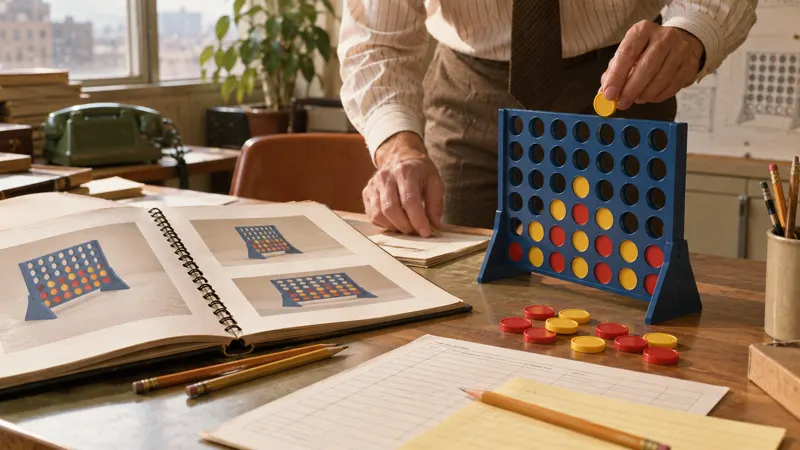
Wexler and Strongin operated briefly as Strongin & Wexler Corp. The partnership licensed Connect Four to Milton Bradley, and the publisher introduced the game in February 1974. Wexler recalls that it initially received little promotion and sat near checkers and school supplies in the back of the company's catalog.
Sales grew later. Wexler dates the major climb to 1979, when television advertising helped make the game widely recognizable. The campaign's sibling rivalry and diagonal win gave the product a personality without changing its simple rules.
The game's journey can be summarized in four steps:
- 1973: Wexler develops and tests the vertical prototype.
- 1973: Strongin & Wexler license the design to Milton Bradley.
- February 1974: Milton Bradley introduces Connect Four commercially.
- 1984: Hasbro acquires Milton Bradley and later carries the game forward.
The release date is supported by the Connect Four historical overview and Wexler's own account of the original game.
What Was Ned Strongin's Role?
Ned Strongin was Wexler's short-term business partner when Connect Four was developed and licensed. Wexler wrote that their arrangement involved sharing financially in products and that Strongin retained an interest in the Connect Four contract when the partnership ended.
That history explains why sources vary. Some call Wexler the inventor and describe Strongin as the partner; others call both men co-inventors. The Strong National Museum of Play's catalog metadata, available through Google Arts & Culture, lists both as designers. Crediting Wexler's hands-on invention while acknowledging Strongin's recognized co-credit avoids erasing either part of the record.
Why the Connect Four Design Endured
Connect Four succeeds because its physical design teaches the rules. Drop a disc and gravity handles the rest. The name states the goal. The whole board is visible to both players, and a round can finish quickly enough to invite an immediate rematch.
The design also leaves room for discovery. New players see simple rows of color; experienced players see support squares, forks, and forced replies. You can explore that depth in our Connect Four strategy guide or try 10 Connect Four variations that build on the original format.
That balance—simple action, visible consequences, and hidden depth—is why a prototype built from plastic tubes became a lasting game.
Frequently Asked Questions
When was Connect Four invented?
Howard Wexler developed the game in 1973. Milton Bradley introduced the commercial version in February 1974.
Did Howard Wexler or Ned Strongin invent Connect Four?
Wexler's first-person history says he conceived and prototyped the game. Strongin was his business partner and is widely co-credited in museum and historical records. It is fair to identify Wexler as the originator while acknowledging Strongin as a credited designer and commercial partner.
Was Connect Four invented by David Bowie?
No. The David Bowie claim is an urban myth. The documented history credits Howard Wexler, with Ned Strongin also appearing in design credits.
What company first sold Connect Four?
Milton Bradley first sold Connect Four in 1974. Hasbro acquired Milton Bradley in 1984 and now publishes the brand.
Was Connect Four based on tic-tac-toe?
It belongs to the broader family of alignment games, but its defining innovation is restricted placement: pieces fall through a vertical grid and occupy the lowest open space. That gravity mechanic changes how players create and block lines.
Play Connect Four Online
Now that you know who invented Connect Four, experience the idea that made the game special: one vertical grid, one falling disc, and dozens of possible plans.
Play Connect Four Online and test the classic design for yourself. Then read our Strategy Guide to learn how to turn Wexler's simple rules into stronger moves.