Connect Four Variations: 10 Fun Ways to Mix Up the Classic Game
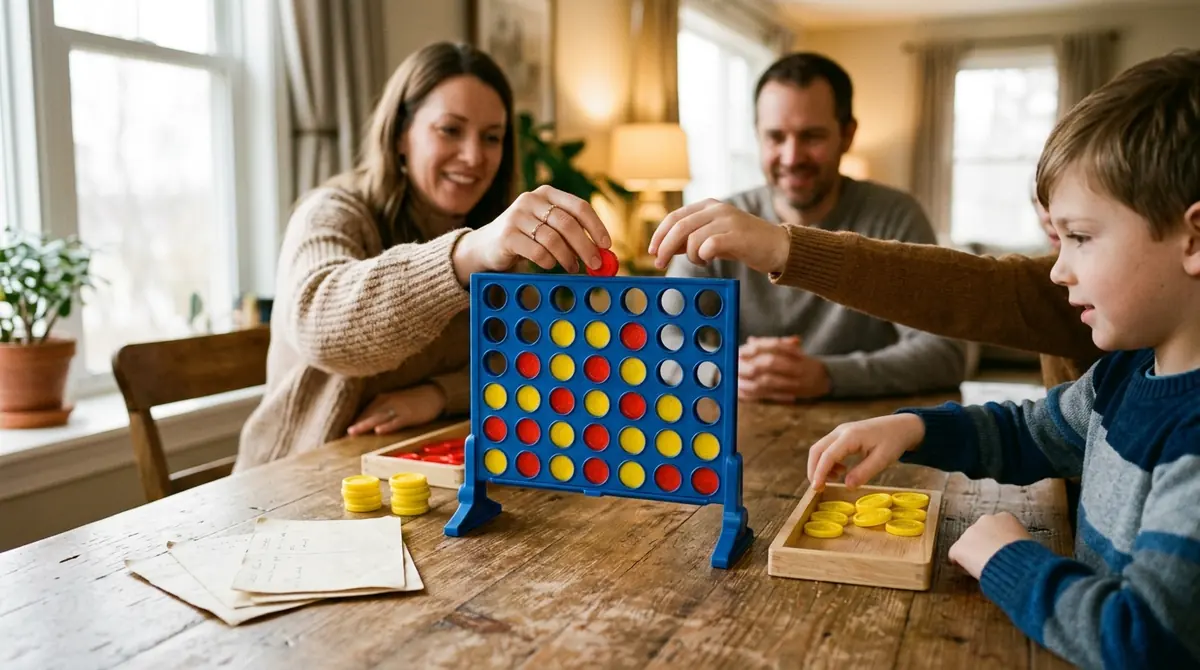
Connect Four variations are the easiest way to make the classic game feel fresh again without buying a new board. The original rules are still great: two players drop discs into a 7-column, 6-row grid and try to connect four in a row horizontally, vertically, or diagonally. But once everyone knows the basics, small rule changes can make games faster, more strategic, more chaotic, or more kid-friendly.
If you need a refresher first, start with our complete guide on how to play Connect Four. If you are playing with younger kids, our Connect Four for kids guide has a gentler teaching path. Then come back here and try one variation at a time.
Curious where the classic format came from? Read the story of who invented Connect Four and how its vertical prototype took shape.
Table of Contents
- Before You Try Connect Four Variations
- 10 Connect Four Variations to Try
- How to Choose the Best Connect Four Variation
- FAQ: Connect Four Variations
- Play Connect Four Online
Before You Try Connect Four Variations
Keep the classic game as your baseline. According to the standard Connect Four format, players alternate turns, each disc falls to the lowest open space in its column, and the first player to make four connected discs wins. That gravity rule is what makes Connect Four different from flat-grid games like tic-tac-toe.
When you add house rules, change only one thing at a time. If you change the win condition, the board size, the turn order, and the scoring all at once, nobody can tell which rule made the game better. A good variation should do one clear job:
- Make the game easier for younger players.
- Make the game harder for experienced players.
- Create a party format for more people.
- Add a time limit or tournament structure.
- Force players to practice a specific skill.
Use the standard rules for the first game of the night, then switch to a variation for rematches.
10 Connect Four Variations to Try
1. Connect Three
Connect Three is the simplest beginner variation. Instead of needing four discs in a row, players only need three.
This works well for younger kids because the goal appears faster and the board is easier to read. Games are shorter, mistakes are easier to recover from, and children get more chances to experience both winning and blocking.
Best for: kids, first-time players, quick warm-up games.
2. Connect Five
Connect Five goes the other direction: players must connect five discs in a row to win.
On a classic 7x6 board, this makes horizontal and diagonal planning more important, because vertical five-in-a-row requires a very tall stack and is easier to block. The game usually lasts longer, and players have to think beyond immediate three-in-a-row threats.
Best for: players who find the classic game too quick.
3. No Center Column for the First Three Turns
The center column is powerful because it touches the most potential winning lines. In this variation, neither player may use the center column until each player has made three moves.
This forces both players to explore edge and near-center positions. It is a useful training rule because beginners often hear “play the center” and then stop thinking. Removing that option temporarily teaches flexibility.
For deeper center-control ideas, read our Connect Four strategy guide.
Best for: strategy practice and players who overuse the center.
4. Timed Turns
Give each player 10, 15, or 30 seconds per move. If a player runs out of time, they must play in the leftmost legal column.
Timed turns change the feel of the game immediately. Strong players cannot calculate forever, and casual players learn to scan the board quickly: can I win, can my opponent win, and what move improves my position?
Best for: tournaments, classrooms, and quick game-night rounds.
5. Best-of-Five Match Play
Instead of treating each game as separate, play a best-of-five match. Alternate who goes first each round and track the score.
This is a small change, but it makes Connect Four feel more balanced. The first player has a theoretical advantage in solved play, so alternating the first move keeps casual matches fairer. It also lets players adjust between games instead of feeling like one mistake ended everything.
Best for: fair rematches and family tournaments.
6. Pop-Out Style
In Pop-Out style, a player may either drop a disc normally or remove one of their own discs from the bottom row of a column. When a disc is removed, everything above it falls down one space.
This variation changes the whole board. A safe position can become dangerous after one removal, and a blocked line can suddenly reopen. Play slowly the first few times, because both players need to check what falls after each pop.
Best for: experienced players who want a more tactical game.
7. Forced Block
If your opponent has three in a row with an open winning space, you must block it unless you can win immediately.
This house rule teaches defensive discipline. It also prevents beginner games where one player misses an obvious threat three turns in a row. Once everyone is spotting threats reliably, remove the rule and return to normal play.
For a full list of practical tactics, use our guide on how to win at Connect Four.
Best for: learning, coaching, and mixed-skill games.
8. Mystery Column Ban
Before the game starts, write one column number on a hidden note. Reveal it after each player has taken two turns. From that point on, the banned column cannot be used.
This adds a little uncertainty without turning Connect Four into pure luck. Players must adapt when an important lane closes, and strong opening plans may need to change quickly.
Best for: casual players who want a light twist.
9. Team Connect Four
Play two versus two. Teammates alternate turns, but they may not discuss moves after the game starts.
Team Connect Four is fun because partners often see the board differently. One player might build a diagonal plan while the other keeps blocking threats. The no-talking rule keeps the game from becoming one strong player controlling every move.
Best for: four-player groups and family game night.
10. Puzzle Mode
Set up a board position and ask one player to find the best move. You can make the puzzle simple, like “Yellow to move: block Red,” or harder, like “Red to move: create two threats.”
Puzzle mode is not a full replacement for normal play, but it is excellent for training. It helps players recognize patterns without the pressure of a live game. You can also replay a real game position and ask, “Where did the winning move appear?”
Best for: practice, teaching, and improving pattern recognition.
How to Choose the Best Connect Four Variation
Use this quick guide:
| Goal | Best variation |
|---|---|
| Teach a young child | Connect Three |
| Make games harder | Connect Five |
| Practice strategy | No Center Column or Puzzle Mode |
| Keep games fast | Timed Turns |
| Run a fair tournament | Best-of-Five Match Play |
| Add chaos | Pop-Out Style or Mystery Column Ban |
| Include four players | Team Connect Four |
The best variation is the one that solves the problem in front of you. If games feel too short, make the win condition harder. If kids feel overwhelmed, make it easier. If one player keeps winning, use match play, timed turns, or a teaching rule that narrows the skill gap.
FAQ: Connect Four Variations
What are the best Connect Four variations for kids?
Connect Three, Forced Block, and Puzzle Mode are the best Connect Four variations for kids. They make the goal easier to see and help children practice one skill at a time.
Can you play Connect Four with more than two players?
The classic game is designed for two players, but Team Connect Four works well with four people. Two players share one color and alternate turns without table talk.
Is Pop-Out an official Connect Four variation?
Pop-Out has been sold as a Connect Four variant, and it is one of the most common alternate ways to play. The core idea is simple: removing a bottom disc changes the position because the pieces above it fall.
Do Connect Four variations make the game less strategic?
Not necessarily. Some variations make the game lighter, but others make it more strategic. Connect Five, Pop-Out style, Puzzle Mode, and timed matches can all make players think about the board in new ways.
Should beginners learn variations before classic Connect Four?
Usually, no. Beginners should learn the classic rules first because most variations depend on understanding normal gravity, blocking, and four-in-a-row threats. After one or two standard games, variations are easier to enjoy.
Play Connect Four Online
Connect Four variations are best when they keep the original game recognizable. Start with one house rule, play a few rounds, and keep the version that makes people ask for a rematch.
Ready to test your favorite version?
→ Play Connect Four Online
→ Read our Strategy Guide
→ Review the beginner rules
For background on the classic 7-column, 6-row game, see the Connect Four overview on Wikipedia. For official product guidance and classic rule wording, Hasbro's Connect 4 instructions are also useful.